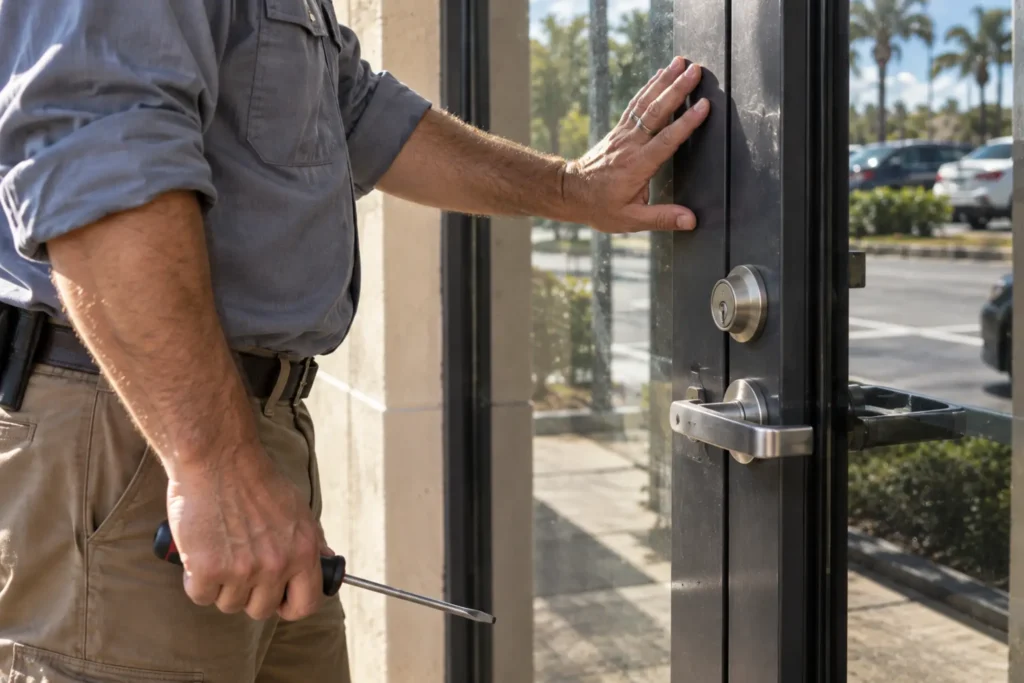
It is 7:40 on a Monday morning. Your first customer is due at eight, the shutters are still down, and the key in your hand will not turn the lock. If you have ever been locked out before opening, you know how fast the panic sets in, and how many bad ideas show up right behind it. A solid commercial lockout checklist keeps you from acting on those ideas.
This guide explains what to do when you are locked out of your business, and more importantly, what to do before you pick up the phone. Most of the steps take a few minutes. Done in order, they protect the people around you, keep your door and frame intact, and give the locksmith the details needed to get you inside faster.
Fine Key Locksmith is a family owned and operated company serving businesses and homeowners across South Florida. Commercial lockouts tend to follow a pattern: the calmer the first ten minutes, the quicker and cheaper the fix. Below is the full business lockout checklist, the mistakes to avoid, and how to keep it from happening twice.
In This Article:
- Why a Commercial Lockout Checklist Matters
- Check Safety Before Anything Else
- Verify Every Entrance and Key
- Notify Your Keyholders and Customers
- Never Force a Door Open
- Locksmith Versus Broken Lock Costs
- What to Tell the Commercial Locksmith
- How to Prevent Employee Lockouts
- Commercial Lockout FAQs
Why a Commercial Lockout Checklist Matters
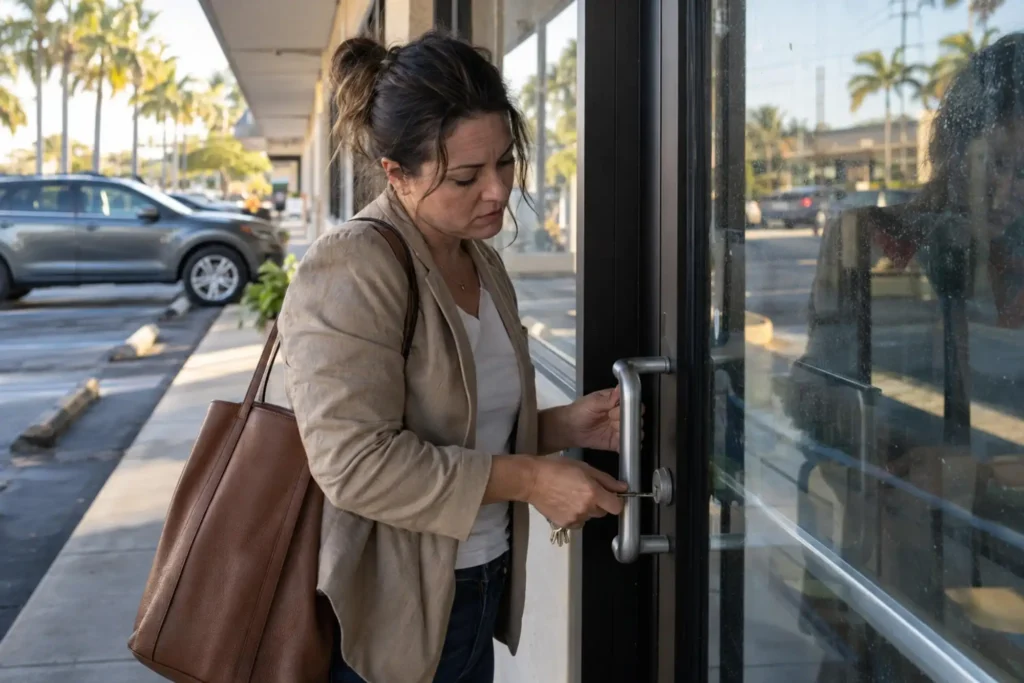
A commercial lockout is not the same as a locked car or a locked house. A business has staff waiting on the sidewalk, deliveries arriving, alarm systems with entry timers, and customers who will not wait long. Every minute outside costs something, so the instinct is to fix it right now by any means available.
That instinct is where most of the damage happens. Owners shove on glass doors, pry at frames with whatever is in the truck, or climb through a loading dock window. The lockout that should have been a short wait turns into a broken frame, a cracked pane, or a safety problem.
A written business lockout checklist solves this. It gives whoever is standing at the door, whether that is the owner, a shift lead, or a new hire, a clear order of operations. Print it, tape it inside the manager’s office, and keep a copy in the shared drive. When the key fails at 6 a.m., nobody has to think. They just work down the list.
The steps below follow the order we recommend to the Boca Raton, Fort Lauderdale, and West Palm Beach businesses we serve. They answer the question we hear most often: what should I do if I’m locked out of my business?
Check Safety Before Anything Else
Before you think about the lock, look at where people are standing. Staff clustered at the entrance can block the sidewalk or a loading area. A delivery driver may be backing up. In South Florida, add the weather: a group waiting in direct afternoon sun or a sudden summer downpour needs shelter more than they need you to be a hero.
Run through these quick checks first:
- Move employees and visitors out of driveways, loading zones, and fire lanes.
- Get anyone who is waiting into shade, a vehicle, or a nearby coffee shop.
- Look for signs the door was tampered with. Fresh scratches around the cylinder, a bent latch, or a cracked frame suggest something other than a simple lockout.
- If you see evidence of forced entry, step away from the door and call the police before anyone enters.
That last point matters. A lock that will not work because someone tried to break in is a different situation from a lock that jammed. If the building may have been entered, you do not want to walk in alone, and you do not want to disturb anything before officers arrive.
If everything looks normal, and the lock simply is not cooperating, take one slow breath and move to the next step.
Verify Every Entrance and Key
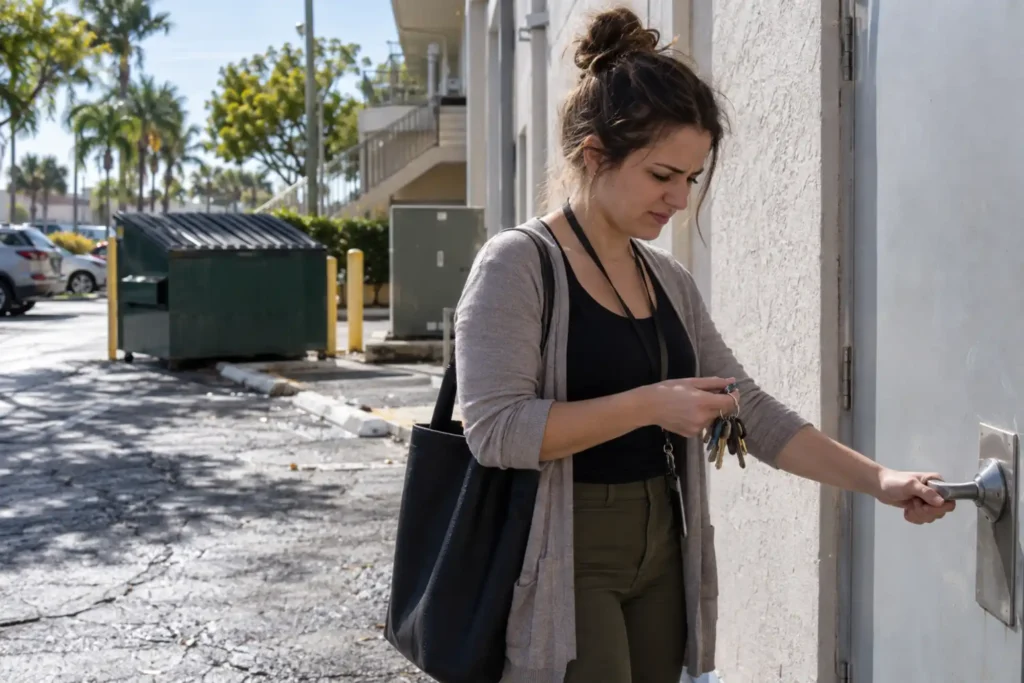
Many lockouts are not lockouts at all. Before you call anyone, confirm that you are truly shut out. It takes about five minutes and can save you a service fee.
Walk the building and try every entrance you have a key for: the side door, the rear service door, the loading dock, the suite door inside a shared hallway. Check the code or keypad on any door that has one. Then test the key itself, because the problem is often the key.
Look at the key in daylight. A worn or bent key can stop turning a lock that it opened for years. If you have a spare, try it. Try the key upside down, since some cylinders accept both orientations and a slightly misaligned insertion can feel like a jam. Do not wiggle it hard. Forcing a key can snap it off in the cylinder, and a broken key in a lock is a much bigger job than a stuck one.
Also check whether the lock is the cause at all. A door that will not open might be held by a deadbolt thrown from inside, a panic bar dogged down, or a magnetic lock that lost power. If the building lost power overnight, an electric strike or maglock may be the real issue, and that is a question for a commercial locksmith rather than a key problem.
If every entrance is secure and the key still fails, you can say with confidence that this is a commercial lockout, and you know something useful to tell the locksmith.
Notify Your Keyholders and Customers
Once you know you are locked out of your business, start making the calls that cost nothing. Reach whoever else holds a key: a business partner, a manager, a property manager, or a landlord with a master. A keyholder ten minutes away is sometimes the quickest fix of all.
Ask a few specific questions. Is anyone inside the building who can open the door? Did the last person to close up report any trouble with the lock? Does the property manager have a key on file, and can they bring it? If your lease puts the building owner in charge of exterior locks, your landlord may need to be part of the call anyway.
Then think about the people who are about to arrive. Post a short message on your phone line, website, or social page if the delay will run past opening time. A text to a standing appointment, or a note taped to the door, keeps customers from standing in a parking lot wondering whether you closed for good.
If your alarm company expects a disarm code within a set window, call them too. Tell them the situation so a late disarm does not trigger a dispatch. Many monitoring companies can note the account for the next hour.
Never Force a Door Open
Should I force a door open during a lockout? In nearly every case, no. This is the single most expensive mistake we see, and it deserves its own warning in your commercial lockout checklist.
Commercial doors are built to resist force. Steel frames, reinforced strike plates, and heavy hinges do exactly what they were installed to do. A shoulder, a pry bar, or a kick will usually fail, and when it does work, it works by bending the frame or splitting the door. Glass storefront doors are worse: one hard hit can shatter the pane, and now you have a safety hazard, a security gap, and a repair that needs a glazier as well as a locksmith.
Avoid every one of these:
- Prying at the door or frame with a screwdriver, crowbar, or tire iron.
- Breaking a window or glass panel to reach the inside handle.
- Drilling into the lock yourself.
- Climbing through a window, roof hatch, or loading dock opening.
- Using online lock picking tricks on a door with a high security cylinder.
There are also real consequences beyond the damage. Self inflicted damage may complicate an insurance claim, and a door that no longer latches properly leaves the building unprotected until it is repaired. A trained commercial locksmith can open most business doors without harming the lock, the door, or the frame. That is a skill, and it is why waiting a short time is almost always the better choice.
Locksmith Versus Broken Lock Costs
People ask whether it is cheaper to call a locksmith than to break a lock. Think about what each path actually involves.
A professional lockout service is typically a single visit. The technician assesses the door, opens it using methods that leave the lock and door undamaged in most cases, and checks that the lock still works. You pay for the call and the labor, and you are back in business.
A forced entry bills in pieces. There may be a replacement door or frame, new hardware, glass repair, a new lock, and a locksmith visit anyway, since the door still has to be secured afterward. Add the hours of lost sales while the building sits open or boarded, and the total usually lands well above what the original service would have cost. We are not quoting numbers here because every door is different, but the structure of the bill is predictable.
There is a security angle too. A broken door leaves you exposed overnight. If a repair cannot be finished the same day, you may need to pay for temporary security or board up the opening, which adds yet another line to the bill.
The calm, boring option is the budget friendly option. Call a commercial locksmith early, and let the person with the tools do the work.
What to Tell the Commercial Locksmith
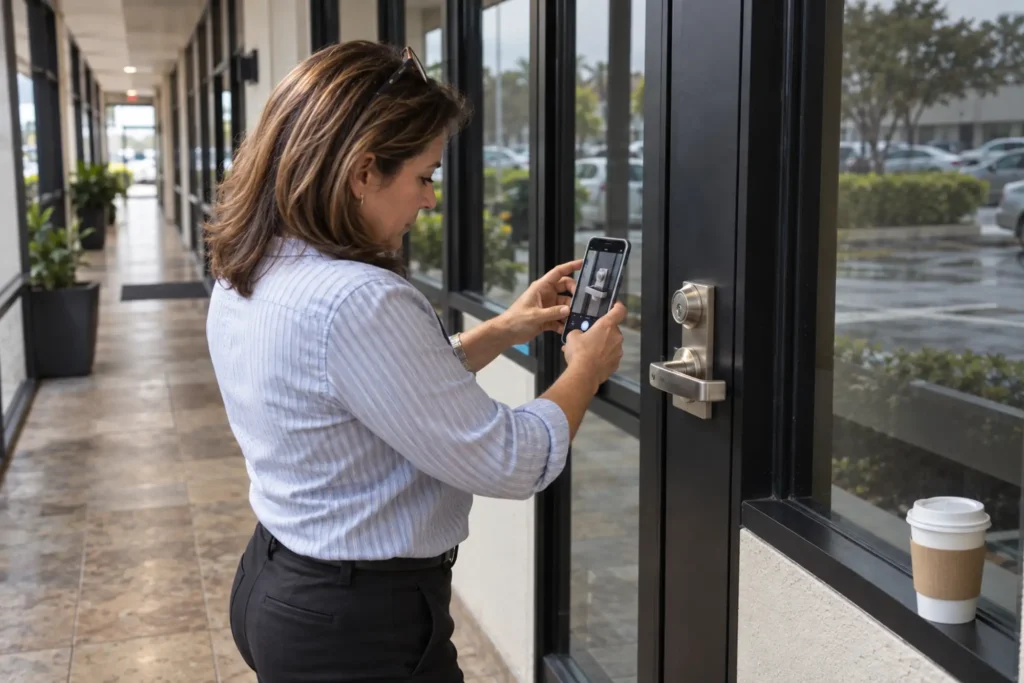
The faster a commercial locksmith understands your situation, the faster the right tools arrive. When you call, have this information ready:
- The full address, including the suite number and which door you are at.
- The type of door: glass storefront, steel, wood, or a rolling gate.
- What kind of lock you have, such as a deadbolt, a keypad, a panic bar, or an electronic access system. A phone photo helps a lot.
- What happened: a key that will not turn, a lost key, a key that broke off, or a keypad that stopped responding.
- Whether the door shows signs of tampering.
- Your name, your role, and proof that you are authorized to enter the building.
That last item surprises people. A reputable locksmith will ask for ID and some proof that you own or lease the space. Do not take it personally. It is the same reason a bank asks for identification, and it protects you from someone else walking into your building by telling a convincing story.
If the lockout involves a key that snapped in the cylinder, say so. The technician will bring extraction tools. If you have a high security or restricted keyway, mention that too, because those keys cannot be copied at a hardware store, which affects how the replacement is handled.
Ready to call? Our team handles emergency lockouts and rekeying for businesses across South Florida, and you can reach us any time at 561-782-5025.
How to Prevent Employee Lockouts
Once you are back inside, take ten minutes to find out why it happened. How do you prevent employee lockouts in the future? The answer usually sits in how keys are handled.
Start with an honest audit. Who has keys right now? If you cannot answer that with a list, you have a key control problem. Keys pile up over the years: former employees, past contractors, a cleaning crew that changed vendors twice. Every unaccounted key is both a lockout risk and a security risk.
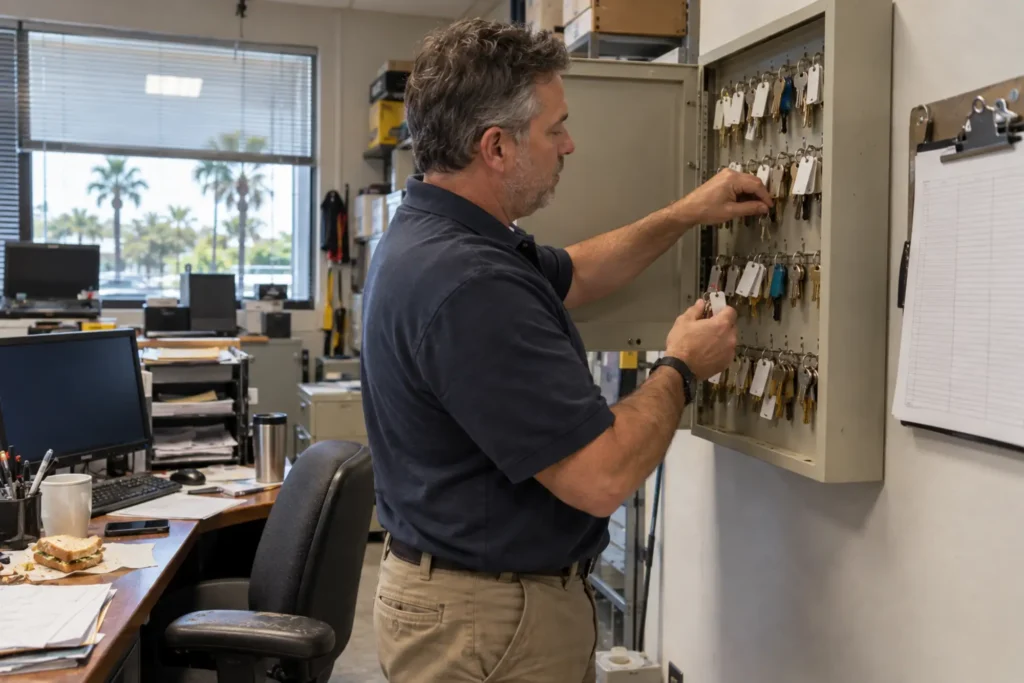
A key control system fixes this. It can be as simple as a signed log that records who holds which key, or as organized as a locked cabinet with numbered hooks and a sign out sheet. Restricted keyways add a layer: those keys cannot be duplicated without authorization from the property owner, so copies do not multiply on their own.
Rekeying is the next step. When a key goes missing or an employee leaves, rekeying changes the inside of the lock so the old key no longer works, without replacing the hardware. It costs far less than new locks, and the same visit can set up a master key arrangement so managers carry one key instead of eight. Our rekeying services are built for exactly this situation.
For businesses with large teams or sensitive areas, consider access control device installation. Keypads and card readers let you cancel one person’s access in seconds instead of collecting a key, and they log every entry, so a lockout is easier to trace.
Finally, build a habit. Assign one person to confirm the keys and the door at opening and closing, and keep a spare set with a trusted keyholder off site. Most employee lockouts come from a missing routine, not from a bad lock.
Commercial Lockout FAQs
What should I do if I’m locked out of my business?
Make sure everyone is safe, check every entrance and your key, call anyone else who holds a key, and then call a commercial locksmith. Do not force the door. Share the address, door type, and lock type when you call.
Should I force a door open during a lockout?
No. Forcing a commercial door usually damages the frame, the lock, or the glass, and it can leave the building unsecured. A locksmith can usually open it without damage.
Is it cheaper to call a locksmith than break a lock?
In most cases, yes. A locksmith visit is one service call. Forced entry can mean a new door, new hardware, glass repair, and a locksmith visit on top of that.
How do I prevent employee lockouts?
Track every key with a log, use a key control system, rekey locks when keys go missing or staff leave, and consider keypads or card readers. A daily opening and closing routine helps too.
Can a commercial locksmith open any business door?
Most doors can be opened without damage, though some high security locks take longer. Tell the locksmith what you have when you call. Expect to show ID or proof that you are allowed to enter.
Locked out of your business? Call Fine Key Locksmith
A commercial lockout is stressful, but it does not have to be a disaster. Protect the people at the door, confirm you are truly locked out, call your keyholders, resist the urge to force anything, and hand the rest to a professional. Then use what you learned to tighten your key control so the same call never happens again.
Fine Key Locksmith is a family owned and operated company that serves businesses and homeowners throughout South Florida. Call us at 561-782-5025 or contact us online, and tell us where you are. We will help you get back inside, and we can help you rekey and organize your keys while we are there. If you serve customers in Fort Lauderdale, Hollywood, or Boca Raton, save this checklist where your team can find it before the next time a lock fails.